Chinese tea: the common wealth of human civilization | Chinese cultural symbols and images
General Secretary Xi Jinping recently emphasized that the inclusion of "Chinese traditional tea-making skills and related customs" in the UNESCO Representative List of the Intangible Cultural Heritage of Humanity is of great significance for promoting Chinese tea culture. We must do a solid job in the systematic protection of intangible cultural heritage, better meet the people's gro wing spiritual and cultural needs, and promote cultural self-confidence and self-reliance. We must promote the creative transformation and innovative development of China's excellent traditional culture, continuously enhance the cohesion of the Chinese nation and the influence of Chinese culture, deepen exchanges and mutual learning among civilizations, tell the story of China's excellent traditional culture well, and promote Chinese culture to better go global.
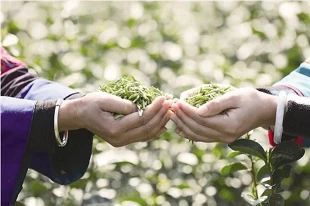
▲From Qingming to Guyu, spring tea picking is busy. Photo by Gong Pukang
Tea, one of the most representative cultural symbols of China, has been demonstrating the charm of Chinese culture together with porcelain, silk and other items since ancient times. This small oriental leaf is an important carrier of Chinese culture and a vivid proof of the interactive evolution of civilizations. The successful application of "Chinese Traditional Tea Making Skills and Related Customs" for World Heritage is a clear proof that Chinese tea culture has been further recognized by the world. Chinese tea will continue to shine all over the world, and the story of Chinese tea will become more exciting.
Time brings gold: Boxing's Chinese tea history
China is the first country in the world to plant tea trees and make tea, and tea culture is deeply integrated into Chinese people's lives. There are many theories about the origin of Chinese tea, among which the most influential one is the explanation of Lu Yu in the "Tea Classic" in the Tang Dynasty: "Tea as a drink originated from Shennong and was known to Zhou Gong of Lu." Gu Yanwu, a scholar in the early Qing Dynasty, mentioned in "Rizhilu" that "tea drinking began after the Qin people conquered Shu", and Ouyang Xiu of the Northern Song Dynasty said in "Collected Ancient Records Postscript" that "tea has been seen in history since the Wei and Jin Dynasties", etc. These records reflect the long history of Chinese tea from the aspects of tea origin and tea drinking.
▲Short video: Wuzhou Juyan: Thousand-year tribute tea, long-lasting tea charm. Video source: Xinhua News Agency
Tea and humans coexist in nature. The cognition and use of tea by Chinese ancestors reflects a profound understanding of the relationship between humans and nature, and between tea and body and mind. "Shennong's Herbal Classic" records that "tea tastes bitter, and drinking it makes people think more, sleep less, lighten the body, and improve eyesight." Mao Wenxi's "Tea Book" in the late Tang Dynasty and the Five Dynasties recorded that Sichuan Mengding tea has the effect of rejuvenating. "Gezhi Mirror Source" compiled by Chen Yuanlong in the Qing Dynasty recorded that "Shennong tasted hundreds of herbs, encountered seventy poisons in one day, and got tea to solve them." There are many such examples. "Tea is a medicine for all diseases", "Tea can keep you healthy", "Tea can detoxify" and other cultural expressions emphasize the efficacy of tea in real life, and also reflect the close relationship between tea and human physical and mental health.
During the Han and Three Kingdoms period, people had a preliminary understanding of the efficacy of tea. Documents such as "Three Kingdoms", "Wuxingji" and "Wu Pu's Herbal" recorded tea and tea culture. Literature shows that people at that time formed relevant understandings such as "long-term drinking of tea can calm the mind and benefit the qi" and "resist aging and hunger and cold". In this context, more effects and meanings of tea were valued, which in turn promoted the formation and spread of tea drinking customs and tea culture.
During the Jin and Jin Dynasties, tea culture was nurtured and sprouted. Initially in southern my country, tea as a drink was more popular among the upper class society. With the movement of officials from the north to the south, the custom of drinking tea gradually spread northward. At that time, tea was also endowed with personality concepts such as integrity, simplicity, and indifference. Literary works began to use tea as an important image, and tea elements were gradually integrated into the cultures of Buddhism, Taoism, and Confucianism.
During the Northern and Southern Dynasties, tea culture developed further. During this period, due to the frequent changes of dynasties and the increase in population mobility, the cultures of different regions and different ethnic groups were able to further learn from each other, creating conditions for the prevalence of tea drinking and the continuous development of tea culture. In comparison, the phenomenon of tea drinking is still more common in the south, with rich records in relevant documents such as "Kunyuan Lu", "Wuxing Ji", "Yiling Illustration", "Chaling Illustration" and "Yongjia Illustration". In addition, there are many records about tea making and drinking. The "Tea Classic" says, "If you don't pick it at the right time, you won't make it well." Shen Huaiyuan of the Southern Dynasties, "Nan Yue Zhi" said, "Tea is bitter." "Guang Ya" says "Pound the powder into a porcelain pot and pour it over with soup", and "Guang Zhi" says "Fry it with paste".
The Tang Dynasty was the flourishing stage of tea culture, and tea making and tea drinking became increasingly popular in society. People have intensified the development of tea. With the advancement of processing technology, various tea production and preservation forms such as coarse tea, loose tea, powdered tea, cake tea, etc. have appeared accordingly. The "Tea Classic" records that "coarse, loose, powdered, baker". During this period, tea steaming, baking, decoction and other technologies became more and more mature. The main procedures include: preparing equipment, selecting water, making fire, waiting for soup, roasting tea, tencha, Luocha, sencha, drinking tea, etc. The supporting equipment for tea drinking is becoming more and more complete, and the aesthetic form is gradually taking shape.
At the same time, works on tea science continued to emerge, such as Jiao Ran's "Tea Jue", Fei Wen's "Tea Description", Zhang Youxin's "Jiancha Water Records", Wen Tingyun's "Tea Picking Records", etc., Lu Yu's "Tea Classic" It was the epoch-making monograph on tea science during this period that promoted the development of Chinese tea culture.
According to the "Preface to the Collection of Flowers and Tea" by Wang Xiangjin of the Ming Dynasty, tea "rose in the Tang Dynasty, flourished in the Song Dynasty, and began to be valued by the world". The Song Dynasty was the heyday of tea culture. Tea was popular among all social classes and became an indispensable item in people's daily lives. The planting, picking, and processing of tea leaves were further developed and improved, and the degree of refinement and technicalization was greatly improved.
In the Song Dynasty, "tea-making" (one of the ancient methods of brewing tea) was popular. From the selection of utensils, water, and fire to the presentation of the effect of tea soup, as well as the physical and mental dedication of tea brewers and tea drinkers and the highlighting of artistic aesthetics, all reflected the characteristics of tea culture at that time. Teaware such as Jian kiln cups with deep glaze bowl walls, which highlight the whiteness of tea soup with color contrast, are deeply loved by the public and greatly promote the development of the ceramic industry in the Song Dynasty. Exquisite and luxurious tribute tea is also a symbol of the prevalence of tea culture in the Song Dynasty. The official tribute tea of Beiyuan in the Song Dynasty was very famous. Every step from picking fresh leaves, selecting tea leaves, washing tea leaves, steaming tea, squeezing tea, grinding tea, making cakes to roasting tea was done with great care.
Driven by the mainstream tea drinking method of making tea, tea has penetrated into all aspects of people's lives in the Song Dynasty. Customs or concepts related to tea, such as the relationship between tea and marriage etiquette, tea and health preservation, have become increasingly rich. At the same time, tea has further become an important subject of literati creation. Poetry, calligraphy and painting related to tea are very prosperous, forming an important label of the poetic life and leisurely mood of literati and scholars. At the same time, tea studies in the Song Dynasty flourished unprecedentedly. At present, there are 30 tea books in the Song Dynasty that can be verified, far exceeding the 14 in the Tang and Five Dynasties. Represented by tribute tea, gifted tea, and tea-horse trade activities, the political attributes of tea in the Song Dynasty were also strengthened. Tea became a medium for close contact between the central government and ethnic minority areas in the border areas, and a link for exchanges and integration among various ethnic groups.
During the Yuan, Ming and Qing Dynasties, the development of tea culture was prominently reflected in the pursuit of the artistry of tea drinking and its further popularization. In particular, the change of the tribute tea method in the Ming Dynasty greatly promoted the popularization of tea drinking culture. The popularity of the brewing method greatly strengthened the mass attributes of tea culture. Popularization became the mainstream and continued to be passed down.
Isomorphism and sharing: interactive integration with tea as the medium
Since ancient times, Chinese people have planted, picked, made and drunk tea. The history of tea is long. As a special economic and cultural carrier, tea has witnessed and promoted the exchanges and integration of various ethnic groups. It is a concrete expression of the mutual learning and integration of various ethnic cultures.
▲Villagers in Aikou Village, Majingao Town, Jishou City, Xiangxi Tujia and Miao Autonomous Prefecture, Hunan Province, prepare "golden tea" to welcome tourists from all over the world. Photo by Sun Wenzhen
Taking the records of "The Classic of Tea" as an example, we can see the interaction and integration of various ethnic groups in the Tang Dynasty with tea as the medium. "The Classic of Tea·Source One" says: "Its name is one, tea, two, 觚, three, four, Ming, and five, 荈." Regarding the name "tea", there are different names in different periods and regions, many of which are related to the names of tea in ethnic regions and ethnic minorities, reflecting that tea culture is shared by multiple ethnic groups. In addition, the relevant content contained in "The Classic of Tea" also shows that the ancient Han people in my country learned about tea trees through multiple ethnic groups in the south, and developed cultivation and management techniques based on learning tea tree planting.
During the Tang and Song dynasties, with the formation of the "Tea Law" and the rise of the tea-horse trade, "using tea to govern the border" became a frontier policy of the central dynasty, and was perfected in the Ming Dynasty. Lang Ying of the Ming Dynasty recorded the "exchange of horses for tea" by the Huihe in the Tang Dynasty in "A Study of Western Tea Exchange for Horses". Another important witness of the tea-horse trade is the ancient Tea-Horse Road that stretches across the roof of the world. The Ancient Tea-Horse Road, which began in the Tang and Song dynasties and flourished in the Ming and Qing dynasties, is an important channel for transporting and trading tea and horses in Chinese history. Its core area starts from the tea-producing areas of Yunnan and Sichuan, and goes all the way west to the hinterland of the Qinghai-Tibet Plateau, such as Lhasa and Shigatse. For more than a thousand years, this ancient road has promoted the economic and trade development, cultural exchanges and ethnic integration in the southwest region, and has become a link to communicate the politics, economy and culture of different regions and ethnic groups.
▲Oil tea. China Nationalities Newspaper Photo Library
In the thousands of years of continuous tea making and drinking, various ethnic groups in my country have also formed colorful tea rituals and customs.
Hunan Qianliang Tea's "Flower Roll Stepping Technique" has a long history. When making flower rolls, workers shout slogans together, and the scene is spectacular, comparable to the scenery; Guangxi Yao oil tea is a tea drinking custom of the Yao people living in the mountainous area of the Nanling Corridor, and is an important part of the Yao people's hospitality and life etiquette; Deang sour tea is made from ancient large-leaf tea trees. The tea soup smells slightly sour, tastes soft and astringent, and has a sweet aftertaste. It is called "solidified mountain spring"...
These colorful and profound tea culture customs are part of China's excellent traditional culture. They have continued and developed in the long river of history and have become a cultural heritage shared by the Chinese nation.
Deep and profound: Tea culture is a continuation of Chinese culture
The traditional tea-making techniques of Chinese tea are mainly concentrated in the four major tea-making areas of Jiangnan, Jiangbei, Southwest and South China, south of the Qinling Mountains and Huaihe River and east of the Qinghai-Tibet Plateau. The relevant customs are widely spread throughout the country and shared by many ethnic groups. The mature and developed traditional tea-making techniques and their extensive and in-depth social practice reflect the creativity and cultural diversity of the Chinese nation, and convey the concept of tea and the world, and inclusiveness.
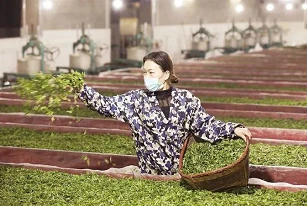
▲A staff member is spreading tea leaves at a tea company in Sanjiang Dong Autonomous County, Liuzhou City, Guangxi Zhuang Autonomous Region. Photo by Gong Pukang
Through tea making, tea brewing and tea tasting, Chinese people have cultivated a peaceful and tolerant mentality, formed a reserved and restrained character, and improved their spiritual realm and moral cultivation. Drinking and sharing tea is an important way for people to communicate and exchange. Tea-related customs such as serving tea to guests and giving priority to the elderly demonstrate the Chinese humanistic spirit of humility, harmony, courtesy and respect. Lu Yu defined tea as an identity label of "fine conduct, thrift and virtue" in "The Classic of Tea". Drinking tea is an important matter for self-cultivation, tempering ambitions and cultivating sentiments. Liu Zhenliang of the Tang Dynasty summarized the spiritual qualities represented by tea with "Ten Virtues of Tea", which are permeated with the ideas of harmony and moderation. Buddhists use tea to "understand Zen", while Taoists use tea to "keep tranquility". The spiritual temperament of Buddhism and Taoism is integrated with the profound connotation of tea.
Tea is used to help literary thoughts and poetry. Tea is considered to have a quiet and elegant character, and has been loved by literati since ancient times. From the carrier of tea culture, tea monographs, tea poems, tea lyrics, tea songs, tea poems, tea calligraphy, tea paintings, tea legends, tea proverbs, tea songs, tea dances, tea dramas, etc., display the tea culture. The rich form and content of culture. "Lingshan is the only mountain that is famous for its wonderful products. It grows grass, and the valleys are covered with hills. It is moistened by the rich soil and receives the dew from the sky..." Du Yu's "Ode on Cumin" by Du Yu in the Western Jin Dynasty is the first tea-themed article in China. The literary works more fully present the tea's origin, growth, picking, water selection, vessel selection, decoction and other scenes, as well as the author's aesthetic perception when drinking, allowing us to truly feel the drinking experience of that era. The way of tea and the realm of tea drinking. Huaisu's calligraphy work "Bitter Bamboo Shoots" is the earliest Buddhist calligraphy related to tea that can be tested, and it is also the product of Zen tea. Although it has only 2 lines and 14 characters, it has become a masterpiece of calligraphy handed down from generation to generation.
There are thousands of tea poems in our country, and the poem styles are diverse, including ancient style, rhythmic poems, quatrains, couplets, bamboo branch poems, test poems, palace poems, pagoda poems, palindrome poems, Dingzhen poems, etc., all of which are related to tea. The works are handed down from generation to generation. Especially in the Tang Dynasty when Lu Yu's "The Book of Tea" appeared, tea poems developed rapidly, with more than 500 poems, and there were countless poems singing about tea in the Song, Yuan, Ming and Qing Dynasties. Today, when we recite poems such as "Taste a bowl of tea and read a line of calligraphy", "Drink a cup of tea, or recite a poem", "Take one or two spoons of night tea, and sing three autumn chants", we are not only I deeply felt the timeless and long-lasting tea culture, and was also touched by the perception of tea and life.
Exchange and mutual learning: Chinese tea loved by people all over the world
Tea was born in China and widely spread in the world. Throughout the ages, through the Silk Road, the Ancient Tea Horse Road, the Tea Road, etc., Chinese tea has crossed history and borders and is deeply loved by people all over the world. It has become an important medium for China and the world to know each other, and for Chinese civilization to exchange and learn from other civilizations in the world, and has become a common wealth of human civilization. At present, more than 60 countries in the world grow tea, and more than 160 countries and regions have the habit of drinking tea.
In the long historical process, Chinese tea varieties and tea culture have spread to all parts of the world in large quantities.
According to existing data, Chinese tea varieties have been introduced to the Korean Peninsula since the second year of Taihe (828) during the reign of Emperor Wenzong of the Tang Dynasty. During the Silla Dynasty, Korea introduced tea trees from the Tang Dynasty and planted them locally, gradually forming a tea culture that blended with local customs and culture. The Korean tea study book "Eastern Tea Song" discusses the philosophical thoughts about tea, especially emphasizing the idea of "neutrality", which is inseparable from the spirit of Chinese tea culture.
In Japan, during the Heian period, Japanese envoys to the Tang Dynasty introduced the method of brewing tea from the Tang Dynasty; during the Kamakura period, the method of making tea from the Song Dynasty was introduced to Japan by Japanese monks; during the Edo period, the method of brewing tea from the Ming Dynasty was spread to Japan. The famous Japanese monk Eisai came to China twice during the Song Dynasty. He not only brought Chinese tea seeds back to Japan and planted them in the Reiwa of Hirado Island, but also wrote the famous Japanese tea book "The Record of Drinking Tea for Health", which had an important influence on the Japanese tea ceremony.
At the same time, Chinese tea also directly opened the curtain of tea planting and production in Britain and Sri Lanka, the major tea producing countries today. In 1780, a small amount of tea seeds had been shipped from China to the British East India Company, and the spread to Sri Lanka can be traced back to 1600.
In the process of dissemination, Chinese tea has been integrated into the customs of various countries and regions, forming a unique local tea drinking culture, and "English afternoon tea" is a prominent representative. In the early 18th century, driven by the British royal family, drinking tea became a fashion pursued by the aristocracy. By the mid-18th century, tea became "the most popular beverage in the UK, and its sales exceeded beer." "Afternoon tea" is an important food culture for the British people and also a leisure culture. Liu Xihong of the Qing Dynasty recorded the "tea party" in Britain in the 18th century in "Ying Yan Si Ji". Whenever there was an important event, there must be a tea party. Jane Pettigrew, a British tea culture expert, specifically introduced the old British tea sets in the book "Tea Design", showing the origin relationship between these British tea sets and traditional Chinese tea sets. In addition, Indian tea pulling, Thai iced tea, Japanese tea ceremony, Korean tea ceremony, etc., are all the products of the combination of Chinese tea and local culture.
Tea originated in China and is popular in the world. Chinese tea culture is broad and profound, and embraces all rivers. It is the embodiment of the Chinese wisdom of "the great way is simple", and also shows the spirit of "harmony but difference" and "beauty in common". The vastness, richness and tolerance of tea have made it a way to communicate with the world since ancient times. In modern times, using "tea" as a bridge to promote exchanges and mutual learning between Eastern and Western civilizations is still of great significance.