Understanding polylactic acid fibers in one article
1. Definition of polylactic acid
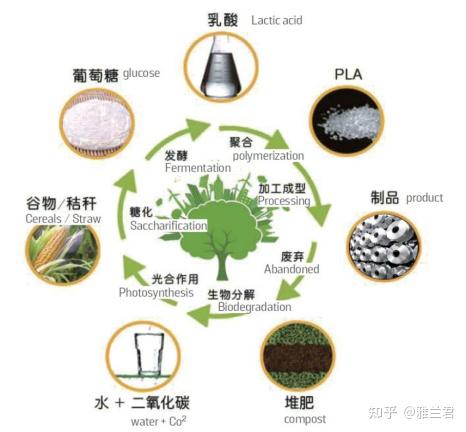
Polylactic acid fiber, commonly known as "corn fiber", also known as "milk silk", is named after the blended variety of polylactic acid fiber and natural fiber launched by Japan Zhongbo in the 1990s. As the name suggests, polylactic acid and corn are "relatives". The first-generation raw material of polylactic acid is corn, and its traceability is: corn → starch → sugar → lactic acid → polylactic acid. All natural biomass raw materials containing starch, cellulose and hemicellulose can be used to produce lactic acid, which can then be polymerized to produce polylactic acid. In order to avoid "Compete with others for food, compete with food for land", non-food crops (such as cassava) can also be used as raw materials, or even agricultural wastes such as straw and straw as raw materials to produce lactic acid and then polylactic acid.
2. Development of polylactic acid
Lactic acid was first found in yogurt. Later, scientists discovered that the acid produced by animal and human muscle movements is lactic acid. The polylactic acid polymer material prepared by polymerizing lactic acid was first invented and produced in the laboratory by the American DuPont Company Carothers (the inventor of nylon).
The research and development of polylactic acid fiber has a history of more than half a century. The American company Cyanamid developed polylactic acid absorbable sutures in the 1960s. Nippon Bellbo and Shimadzu Corporation cooperated to develop pure polylactic acid fiber and its blended varieties with natural fibers in 1989, and exhibited them at the 1998 Nagano Winter Games; Japan's Unitika Company developed it in 2000 Polylactic acid filaments and spunbond nonwovens. The American Cargill Dow Polymers (CDP) company (now NatureWorks) released a series of products (IngeoTM) covering polylactic acid resin, fiber, and film in 2003, and licensed the German Trevira company to produce the IngeoTM series of nonwoven fabrics for automobiles, home textiles, and hygiene. and other fields.
There are also many units in my country that have carried out related research and development and industrialization of polylactic acid fiber, such as Maanshan Tongjieliang Biomaterials Co., Ltd., Hengtian Yangtze Biomaterials Co., Ltd., Anhui Fengyuan Group, Shanghai Defulun Chemical Fiber Co., Ltd., etc.
3. Process and application of polylactic acid fiber
The current mainstream polylactic acid fibers use high optical purity L-lactic acid (PLLA) as raw material, taking advantage of its high crystallinity and high orientation characteristics, through different spinning processes (melt spinning, wet spinning, dry spinning, dry-wet spinning , electrospinning, etc.) prepared. Among them, melt-spun polylactic acid fiber (filament, short fiber) can be used in clothing, home textiles and other fields. The production equipment and process are close to polyester, and it has good spinnability and moderate performance. After appropriate modification, polylactic acid fiber can obtain better flame retardant (self-extinguishing) and natural antibacterial properties. However, melt-spun polylactic acid fiber still has room for improvement in terms of mechanical strength, high temperature dimensional stability, rebound and anti-aging.
Wet spinning, dry spinning, dry-wet spinning and electrospinning polylactic acid fibers (membranes) are mainly used in the biomedical field. Representative products include: high-strength absorbable sutures, drug carriers, anti-adhesion septa, artificial skin, and tissue engineering. Bracket etc.
With the surge in demand for disposable nonwovens in the fields of medical care, sanitary materials, filtration, decoration and other fields, polylactic acid nonwovens have also become one of the hot spots for research and development.
The University of Tennessee in the United States first studied polylactic acid spunbond and meltblown nonwovens in the 1990s. Japan Shobo subsequently developed polylactic acid spunbond nonwovens for agricultural applications. French Fibreweb developed polylactic acid spunbond. , melt-blown nonwoven fabrics and multi-layer composite structures. Among them, the spunbond nonwoven fabric layer mainly provides mechanical support, and the meltblown nonwoven fabric layer and the spunbond nonwoven fabric layer jointly provide barrier, adsorption, filtration, thermal insulation and other functions.
Domestic Tongji University, Shanghai Tongjieliang Biomaterials Co., Ltd., Hengtian Changjiang Biomaterials Co., Ltd. and other units have successfully developed spunbond, spunlace, and hot-rolled composite fibers for nonwovens and nonwovens product development. , hot air and other non-woven fabrics, used in disposable sanitary products such as sanitary napkins and diapers, as well as products such as facial masks, tea bags, air and water filtration materials.
Polylactic acid fiber has been promoted and applied in automobile interiors, cigarette tows, etc. due to its advantages of natural origin, biodegradability and environmental protection.
4. Characteristics of polylactic acid fiber
One of the widely praised advantages of polylactic acid fiber is that it is biodegradable or absorbed in the body. Biodegradability must be determined under standard composting conditions, and the degradation products are water and carbon dioxide. Conventional polylactic acid fiber only hydrolyzes slowly or even undetectably in normal use or in most natural environments. For example, it basically does not degrade when buried in natural soil for 1 year, but it degrades in about 1 week under normal temperature composting conditions.
The degradation and absorption of polylactic acid fiber in the body is greatly affected by its crystallinity. Simulated in vitro degradation experiments show that highly crystalline polylactic acid fiber still basically maintains its shape and nearly 80% of its strength after 5.3 years, and it may take 40-50 years to degrade. completely.
5. Innovation and expansion of polylactic acid fiber
As a chemical fiber variety that has been developed and produced for more than half a century, the current actual usage of polylactic acid fiber is still less than one thousandth that of polyester. Although cost factors are high, performance shortcomings cannot be ignored. Leveraging strengths and avoiding weaknesses through modification is the only way to develop polylactic acid fiber.
my country is a major producer and consumer of chemical fibers and has been in a leading position in research on modified polylactic acid fibers in recent years. Polylactic acid fiber can be blended with traditional natural "cotton, linen, wool and silk" to make woven and knitted fabrics with complementary properties, and can also be blended with other chemical fibers such as spandex, PTT, etc. to make fabrics that are skin-friendly, breathable, and Moisture wicking and other functions have been promoted in underwear fabrics. Tongji University, Ningbo Institute of Materials Science, Chinese Academy of Sciences, Donghua University, Suzhou University, Jiaxing University, Shanghai Tongjieliang Biomaterials Company, etc. have carried out a large number of technology development and product promotions.
Inspired by the "alloying" of plastics, researchers from the Ningbo Institute of Materials, Chinese Academy of Sciences used another commercial biodegradable resin (polyhydroxyalkanoate) and polylactic acid to blend and spin, and developed a new alloy-modified polylactic acid fiber. It has good dyeability and is naturally antibacterial and can be used in high-value textiles and medical and health fields.